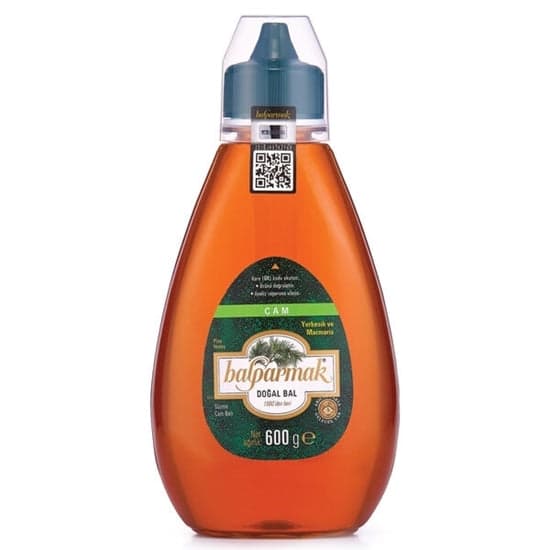
Pine honey is different from blossom honey: bees do not make it from flower nectar but from the sweet secretions of scale insects living on pine trees, which is why it is known as a honeydew honey. The producer says Türkiye accounts for roughly 92% of the world's pine honey production, and this Balparmak bottle is gathered mainly from the pine forests around Yerkesik and Marmaris in south-west Türkiye. The maker describes it as dark in colour, with a resinous, soft flavour. The ingredient list is a single item: strained pine honey.
The snap-cap bottle is squeezed to pour, which the maker presents as a practical and hygienic way to use it at the table. In Turkey pine honey is a breakfast favourite: drizzle it over kaymak or clotted cream, spread it on bread with butter, or pair it with tahini and walnuts. It also goes well in a glass of warm milk, over porridge and yoghurt, or as the sweetener for lemon and herbal tea, and it can be used in dressings and glazes. Honey must not be given to babies under one year old.
Keep the bottle closed in a cool, dry place. The label carries a QR code that, according to the maker, lets you enter the batch number and view that batch's analysis report.