

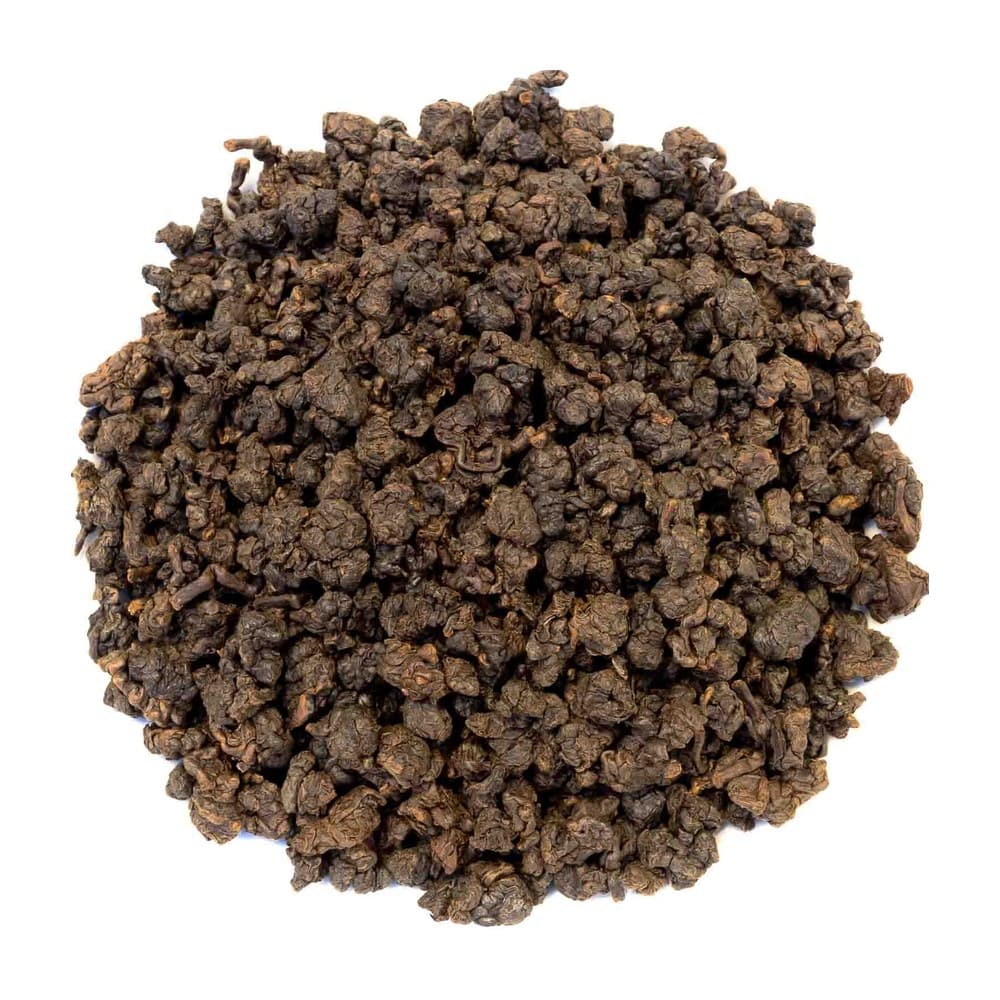
Red Jade GABA (Deep Baked)
Product Specifications
| Product Code | CUR-D09.4 |
|---|---|
| Size | 50g |
Ask Bio about this product
AI assistant · instant answers
Deep Baked Red Jade GABA is a heavily roasted GABA-rich tea crafted from an organically grown Red Jade cultivar. Tightly rolled leaves produce a bold liquor with a strong roasted flavour, malty notes of fruits and raisins and a long-lasting lightly mineral aftertaste.
Get a reminder for regular delivery and save with code SUBSCRIBE10 at checkout. Pause or cancel anytime.
Supplied and dispatched by Curious Tea View store →
Description
Deep Baked Red Jade GABA (深度焙紅玉佳葉龍) is a deeply roasted version of our award-winning Red Jade GABA. Crafted from the Hong Yu TRES No. 18 cultivar, this version undergoes multiple slow roasting sessions over the course of at least one year. This careful roasting process introduces heavy roasted notes that deliver a complex flavour throughout multiple infusions. This batch is from the March 2025 harvest. We source it from Mr Yu via our Taiwanese tea master who does the baking of this tea.
The Red Jade cultivar was developed in Taiwan very recently in an attempt to reinvigorate black tea production in the country. This cultivar was developed from an Assamica strain from Burma and the local wild tea from Taiwan. Incidentally, the Taiwanese Wild Shan Cha is available to buy in our online shop, where you can also read more about that unique strain of Camellia. Wild Shan Cha compares interestingly to the new Red Jade cultivar. They both exhibit similar qualities; however, the teas made with the new Red Jade cultivar have a unique eucalyptus and mint edge to them. But if you try them side by side you can definitely see the ancestral relationship between them. Our Yuchi Red Jade is also crafted from the Hong Yu cultivar.
Our Deep Baked Red Jade GABA black tea is organically grown around Mingjian Township of Nantou County. After harvesting and rolling, this tea undergoes oxidation in an oxygen-deprived environment. This is the unique process that is employed to achieve all GABA teas. The tea is placed into large tanks. Oxygen is then flushed out with nitrogen and the tea is left to oxidise. As the environment is oxygen-deprived, the oxidation process happens very slowly. This results in a much larger amount of GABA molecules being present in the finished tea.
After the initial processing, this tea undergoes extensive baking. While it is possible to achieve a high degree of baking in a short period of time, it leads to an unstable flavour that dissipates very quickly. This is the reason most roasted oolong teas are only made available much later after the harvest, or in the case of this tea, at least a year after the harvest. This time allows the tea master to carry out multiple slow roasting sessions, which are designed to emulate traditional charcoal roasting. These are typically done at least every 2 to 3 months, which slowly infuses the deep roasted flavours into the leaf. So while it is a more labour-intensive process, the resulting tea will be more complex and will retain the flavours through more infusions. In practice, tea that undergoes any level of baking becomes more stable, resulting in a longer shelf life and flavour stability.
This Deep Baked Red Jade GABA black tea comes in tightly rolled oolong-style leaves, producing a bold liquor with a strong roasted aroma. The deep roasted flavour dominates the profile, though the underlying GABA fruitiness remains present. Although the strength of the roast mutes some of those brighter fruit notes, on the plus side, this tea lacks the sharp, tart acidity sometimes found in unroasted GABA teas. There are still malty notes of fruits and raisins present as well as a smooth, coating mouthfeel. The aftertaste is long-lasting with a strong mineral and roasted profile. This tea will definitely appeal to fans of heavily roasted oolong teas!
This tea is best brewed with water at 90°C for 3-5 minutes and can be brewed multiple times.
For gongfu brewing, we suggest using 5g of leaf per 100ml in a gaiwan or clay teapot with water at 90–95°C. Start with an optional 5-second rinse, followed by a first infusion of 20 seconds, a second for 15 seconds, and a third for 20 seconds, adding 10–15 seconds to each subsequent steep. A temperature of 90°C highlights the underlying malty and fruity notes, while the higher temperature of 95°C brings out more of that roasted character and deeper mineral finish.
Questions & answers
Ask Bio — questions answered by our team are published here.
No published questions yet. Ask Bio — once our team answers, it appears here.
Similar Options
Other choices in this category
Complete Your Basket
Goes well with this product
Customers also bought
Based on real order data