

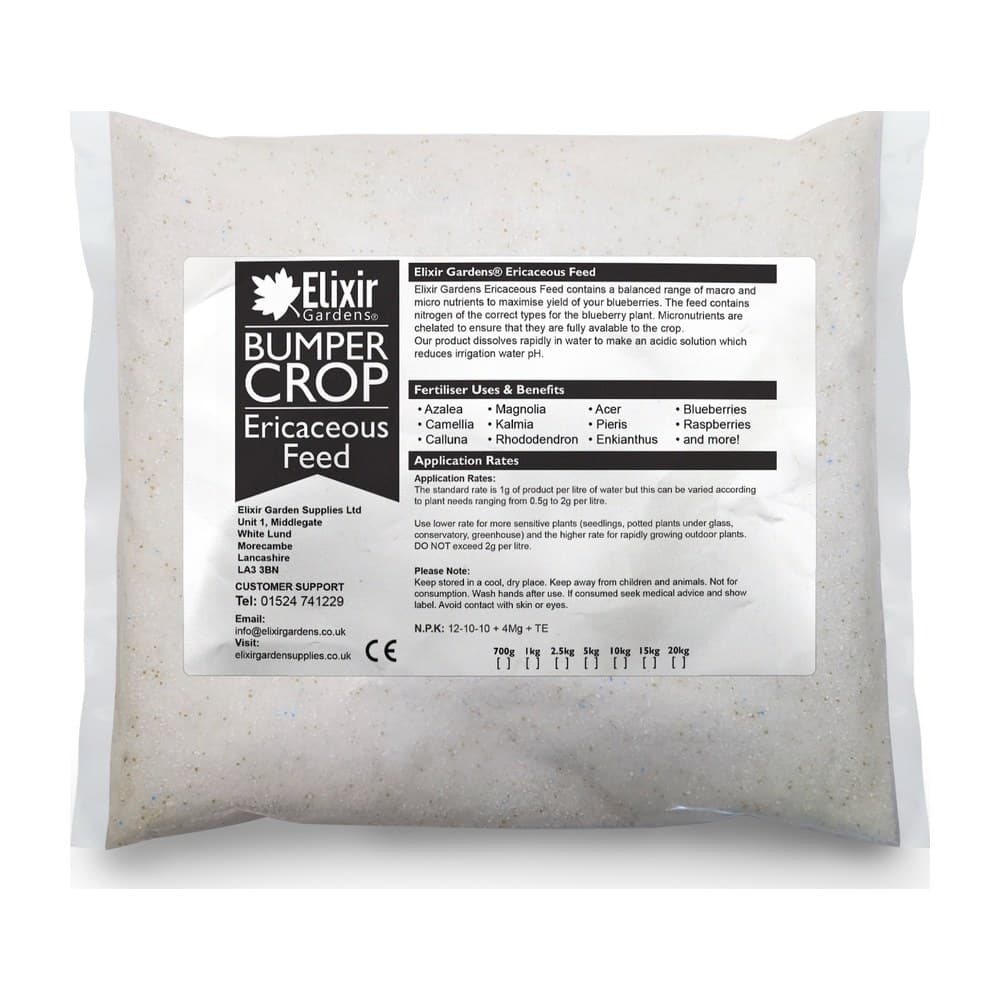
Bumper Crop Ericaceous Fertiliser | Azalea, Camellia, Acer & Rhododendron Food (12-10-10+4%Mg)
Product Specifications
| Product Code | EGS-BUMP_ERICA_FEED_BAG_700G |
|---|---|
| Size | polythene-bag / 700g |
Supplied In: polythene-bag
Ask Bio about this product
AI assistant · instant answers
A COMPLETE FEED – Made to provide a complete soluble NPK feed for container or soil grown Ericaceous plants, especially where the irrigation water contains more than 150ppm bicarbonates. MAXIMISE YOUR YIELD – Elixir’s Ericaceous Feed contains a balanced range of micro and macro nutrients to maximise
Get a reminder for regular delivery and save with code SUBSCRIBE10 at checkout. Pause or cancel anytime.
Supplied and dispatched by Elixir Garden Supplies View store →
Description
This versatile 12-10-10 fertiliser is the exact same formula, whether marketed for [Blueberry Special], [Early Season], or [Ericaceous]. It gives balanced nutrition and supports healthy growth for a range of plants.
Bumper Crop Ericaceous Fertiliser is a liquid & foliar plant feed suited towards plants that don’t like growing in soils containing lime. They are also known as “Acid-loving plants”. These plants will not grow well in alkaline soils with a high pH. Examples of these plants are Rhododendron, Camellia, Azalea, Pieris, summer-flowering heathers (calluna) and even Japanese Maples (Acer) among others. As most ericaceous plants, especially rhododendrons, azaleas, camellias and heathers are shallow rooted. As such they are prone to dying out during prolonged dry periods. So it is very important to keep the soil or compost moist. This is especially important in summer, when flower buds are setting. If the soil or compost does get too dry during this time, then plants may fail to flower. So it is recommended that you water plants weekly during dry periods, and mulch soil well to preserve moisture.
Applications
Liquid Feed:
The standard rate is 1g / litre of water. However this can vary anywhere between 0.5g / litre – 2g / litre. Use the lower rates for sensitive plants, such as pot plants under glass. The higher rates should be used on rapidly growing plants in outdoor soils. Do not use more than 2g / litre.
Used in the same way as other water-soluble fertilisers. Ericaceous feed is usually applied via a normal watering can. Simply add the appropriate amount of feed to the can, add water and apply liberally to the plant root area. A very approximate guide is 5litres / square metre.
The feed is best applied as a liquid feed whilst the plant is actively growing. Ideally alongside watering.
Foliar Feed:
Plants are designed to take up nutrients through their roots, but most nutrients can be absorbed through the leaves. Foliar feeding can give crops a valuable boost. Particularly if the root system is not functioning well due to drought, disease or pest attack and other stress factors. Ericaceous feed can be applied to plant foliage via a hand or knapsack sprayer or similar equipment. Prepare a 0.05 – 0.1% (0.5 – 1.0 g / litre) solution and apply to coat the leaves and stems with a thin film of moisture, with little or no “run-off”. Do not exceed a 1g / litre concentration.
Whilst using a sprayer the following points should be observed:
- Use a sprayer nozzle that produces a fine mist.
- Only apply sufficient spray solution to to coat the leaves and stems with a film of moisture with little or no “run-off”.
- Carry out spraying on a calm day, but not during strong sunshine or high temperatures. The best time is late afternoon or evening.
- Postpone spraying if rain is imminent. If rain falls within 4 hours of spraying, re-spray the crops 3 or 4 days later.
- For application via hose-end diluters, please refer to the device manufacturer’s directions for use.
- If you are in an area with acute hard water, Soluble NPK fertilisers can dry on the leaves and leave unsightly residues.
Examples of Ericaceous plants:
- Azalea
- Blueberry
- Camellia
- Calluna
- Enkianthus
- Gaultheria
- Kalmia
- Pieris
- Rhododendron
Examples of Acid-Loving plants:
- Acer (Japanese maple)
- Magnolia (except M. x loebneri and M. stellata)
- Raspberries
- Skimmia
Mineral Analysis:
| Names | Percentages |
|---|---|
| NH4 – N | 10.7% |
| Ureic – N | 1.3% |
| P2O5 | 10% |
| K2O (K) | 10.8% |
| MgO (Mg) | 4.7% |
| SO3 (Mg) | 46% |
| B soluble in water | 0.020% |
| Cu chelated by EDTA | 0.006% |
| Fe chelated by EDTA | 0.060% |
| Mn chelated by EDTA | 0.030% |
| BMo soluble in water | 0.002% |
| Zn chelated by EDTA | 0.016% |
Questions & answers
Ask Bio — questions answered by our team are published here.
No published questions yet. Ask Bio — once our team answers, it appears here.
Similar Options
Other choices in this category
Complete Your Basket
Goes well with this product
Customers also bought
Based on real order data